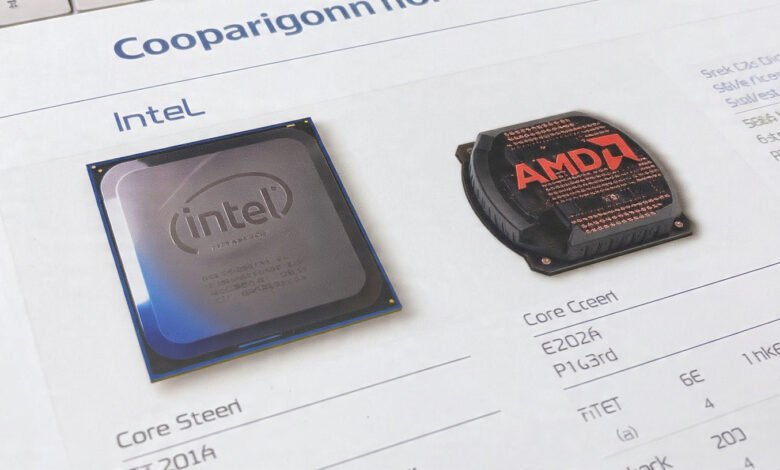
The Intel vs AMD debate has reached a fascinating turning point in 2026. After years of competitive back-and-forth, both chipmakers have delivered compelling processors that cater to different needs. Whether you’re building a high-refresh gaming rig, a content creation workstation, or a budget-friendly PC, understanding the current landscape between AMD and Intel will save you money and frustration.
This year, AMD’s Ryzen 7 9800X3D and Intel’s Core Ultra 9 285K represent the pinnacle of consumer desktop performance, but they excel in dramatically different ways. AMD continues to dominate pure gaming scenarios with its revolutionary 3D V-Cache technology, while Intel pushes forward with hybrid architecture designs aimed at multi-threaded productivity workloads. The choice between these CPU manufacturers isn’t about finding a universal winner anymore—it’s about matching the right processor to your specific workflow.
In this comprehensive guide, we’ll break down real-world performance benchmarks, analyze value propositions across different price segments, and help you make an informed decision about which CPU brand deserves your hard-earned money. Whether you prioritize frame rates, rendering speeds, power efficiency, or simply getting the most performance per dollar, this analysis will give you the clarity you need to choose confidently.
Understanding the 2026 CPU Landscape: What’s Changed
The processor market in 2026 looks dramatically different than it did just a few years ago. AMD’s market share has climbed to 39.3% in desktop CPU revenue as of Q2 2025, representing a 20.5% year-over-year increase. This growth reflects genuine performance advantages that AMD has built through superior architecture and strategic manufacturing partnerships with TSMC.
Intel no longer holds the overwhelming dominance it enjoyed from 2012 to 2018. The company now outsells AMD at approximately a 2:1 ratio in desktop units, down from the staggering 9:1 advantage it maintained during the mid-2010s. This shift isn’t arbitrary—it reflects consumer recognition of AMD’s compelling value proposition and consistent performance leadership in key categories.
Current Generation Overview
AMD’s Ryzen 9000 series processors, built on the Zen 5 architecture using a refined 4nm process, represent the company’s latest desktop offerings. The standout models include the Ryzen 7 9800X3D ($480) for gaming enthusiasts, the Ryzen 9 9950X3D for users who demand both gaming and productivity excellence, and budget-friendly options like the Ryzen 5 9600X ($186).
Intel’s Core Ultra series, featuring Arrow Lake architecture manufactured on a 3nm process, marks a significant platform shift for the company. The flagship Core Ultra 9 285K ($590-$630) employs a hybrid design combining Performance cores and Efficient cores, while mid-range options like the Core Ultra 7 265K ($399-$429) offer balanced capabilities for mixed workloads.

Gaming Performance: AMD Takes the Crown
When evaluating the best CPU for gaming in 2026, AMD’s X3D processors establish clear dominance across virtually every title and resolution. The technology behind this superiority lies in AMD’s innovative 3D V-Cache, which stacks 64MB of additional L3 cache directly onto the processor die.
Real-World Gaming Benchmarks
The Ryzen 7 9800X3D delivers devastating gaming performance that positions it as the undisputed gaming champion. Independent benchmarks consistently show the 9800X3D outperforming Intel’s Core Ultra 9 285K by an average of 35%, with gains reaching up to 40-45% in specific titles.
In Cyberpunk 2077, the 9800X3D achieves 143.7 FPS compared to the 285K’s 118.9 FPS—a 21% advantage. The performance gap becomes even more pronounced in titles like:
- Star Wars Jedi: Survivor: 51% faster on AMD
- Assetto Corsa Competizione: 75% faster on AMD
- Hogwarts Legacy: 43% faster on AMD
- Homeworld 3: 58% better average FPS, 117% improvement in 1% lows
- A Plague Tale: Requiem: 59% performance boost
Why 3D V-Cache Matters for Gaming
Modern games have non-sequential memory access patterns with limited predictability, making them highly sensitive to memory latency rather than just bandwidth. The Ryzen 7 9800X3D’s massive 96MB L3 cache serves as an effective buffer against memory access penalties, keeping critical game data close to the execution cores.
This architectural advantage translates to higher frame rates and significantly better frame consistency. The improved 1% low performance means fewer stutters and a smoother overall gaming experience, especially on high-refresh monitors running at 144Hz, 240Hz, or even 360Hz.
Intel’s Gaming Position
The Intel Core Ultra 9 285K isn’t a terrible gaming processor—it’s just comprehensively outclassed by AMD’s specialized gaming chips. Intel performs competitively in older DirectX 11 titles and games that favor raw clock speed over cache capacity. However, in modern AAA games and esports titles optimized for current-generation engines, the 285K consistently falls behind.
Productivity & Content Creation: A More Nuanced Battle
For productivity workloads, the performance comparison between Intel and AMD becomes more complex and application-dependent. Both companies offer compelling options, but they excel in different scenarios.
Multi-Threaded Performance
Intel’s Core Ultra 9 285K demonstrates significant advantages in heavily parallelized workloads. In Cinebench 2024’s multi-core benchmark, the 285K scores 2496 compared to the Ryzen 7 9800X3D’s 1376—an 81% lead for Intel. This gap widens further in POV-Ray’s multi-core test, where Intel achieves 15,464 PPS versus AMD’s 7,783, representing a 98.6% advantage.
These synthetic benchmarks translate to real advantages in specific professional applications:
Best for Intel:
- 3D rendering in CPU-based engines
- Video encoding tasks leveraging Intel Quick Sync
- Scientific computing and simulation workloads
- Compilation of large codebases
- Applications optimized for Intel’s instruction sets
Best for AMD:
- DaVinci Resolve workflows
- Blender rendering with Zen 5 optimizations
- Adobe Photoshop (where the 9800X3D actually outperforms the 285K)
- Mixed gaming and streaming scenarios
- Tasks requiring sustained performance without thermal throttling
Hybrid Workloads: The Real-World Consideration
For professionals who game extensively while also handling content creation, the Ryzen 9 9950X3D represents the strongest option available in 2026. It combines elite gaming performance with workstation-class multitasking capabilities, delivering approximately 20% better gaming performance than Intel’s flagship while maintaining competitive productivity capabilities.
The Intel Core Ultra 7 265K offers an excellent middle path for users who balance gaming, creation, and everyday productivity with equal emphasis. Its hybrid architecture intelligently allocates tasks between Performance cores and Efficient cores, maintaining system responsiveness even under heavy multitasking scenarios.
Power Efficiency & Thermal Performance
Power consumption represents one area where AMD establishes clear leadership. The architectural efficiency of AMD’s Zen 5 design, combined with TSMC’s advanced 4nm manufacturing process, results in significantly lower power draw compared to Intel’s offerings.
Real Power Consumption Numbers
The Ryzen 7 9800X3D has a TDP of 120W but rarely reaches that limit in real-world gaming scenarios. Actual gaming power consumption typically hovers around 60-80W, making it remarkably efficient for a high-performance desktop processor.
The Intel Core Ultra 9 285K, despite improvements from previous generations, can draw up to 250W under full load. While Intel has made massive strides in efficiency with the Core Ultra 200S series, their flagship chips still require more robust cooling solutions.
Cooling Requirements & System Costs
This power efficiency difference has practical implications:
AMD advantages:
- Compatible with more affordable tower coolers
- Less expensive motherboard VRM requirements
- Lower electricity costs over the system’s lifetime
- Quieter operation due to reduced fan speeds
- Better performance in small form factor builds
Intel considerations:
- High-end models benefit from 360mm AIO liquid cooling
- Requires motherboards with more robust power delivery
- Higher sustained load temperatures
- May require case upgrades for adequate airflow
The Ryzen 7 9800X3D particularly benefits from undervolting using AMD’s Curve Optimizer, which can reduce temperatures and power consumption further while maintaining full performance. This flexibility allows enthusiasts to create cooler, quieter systems without sacrificing gaming prowess.
Budget & Value Analysis: Price-to-Performance in 2026
When evaluating the best CPU for different budget tiers, both AMD and Intel offer compelling options, though AMD currently holds advantages in most price segments.
High-End Segment ($450-$650)
AMD Ryzen 7 9800X3D ($480): Delivers unmatched gaming performance that Intel cannot match at any price point. Represents the best value in this segment for gaming-focused builds.
Intel Core Ultra 9 285K ($590-$630): Costs $110-$150 more than the 9800X3D while delivering substantially worse gaming results. Better suited for productivity-focused workstations where multi-core throughput justifies the premium.
AMD Ryzen 9 9950X3D: For users who refuse to compromise on either gaming or productivity, this represents the ultimate desktop processor, though at a higher price point.
Mid-Range Segment ($200-$400)
This price bracket offers excellent options from both manufacturers:
AMD Ryzen 5 9600X ($186-$192): Six Zen 5 cores deliver strong 1080p and 1440p gaming performance with excellent efficiency. Recent firmware updates have significantly improved its standing.
AMD Ryzen 7 7800X3D: When on sale, this previous-generation X3D chip offers outstanding gaming value, though availability fluctuates.
Intel Core Ultra 7 265K ($399-$429): Solid choice for users splitting time between light content work and mainstream gaming. The hybrid architecture provides versatility.
Intel Core i5-14600K: Offers 14 cores (6 P-cores + 8 E-cores) with strong multi-threaded performance for users who prioritize productivity over pure gaming.
Budget Segment ($100-$200)
Budget builders face interesting choices in 2026:
AMD’s AM4 platform remains viable for extreme budget builds, offering upgrade paths and motherboard availability at rock-bottom prices. Options like older Ryzen 5 chips provide acceptable gaming performance for 1080p scenarios.
Intel Core i5 options in this range struggle to match AMD’s value proposition, though they remain serviceable for general computing and light gaming.
Platform Costs & Long-Term Value
When calculating total system costs, consider these platform differences:
AMD AM5 advantages:
- Socket supported through 2027+
- Future CPU upgrades without motherboard changes
- DDR5 memory standard across the platform
- PCIe 5.0 support for future expansion
Intel LGA 1851 considerations:
- Newer platform with less upgrade clarity
- Traditional Intel approach to socket changes
- DDR5 requirements increase initial costs
- Excellent motherboard selection from major vendors
Platform Features & Upgrade Path
AMD’s Long-Term Strategy
AMD has committed to supporting the AM5 socket through 2027 and likely beyond. This approach allows users to upgrade their CPU without replacing their entire motherboard and memory configuration, significantly reducing long-term costs for enthusiasts who like to stay current with processor technology.
The AM5 platform includes:
- DDR5 memory support (required)
- PCIe 5.0 for graphics cards and NVMe drives
- Integrated graphics on all processors (except X3D models)
- Consistent chipset feature sets across generations
- Excellent motherboard options from budget to premium
Intel’s Platform Approach
Intel’s LGA 1851 socket, introduced with Arrow Lake processors, represents a fresh platform with uncertain longevity. Intel historically changes sockets more frequently than AMD, though the company hasn’t confirmed how long LGA 1851 will remain current.
Platform features include:
- DDR5 memory required
- PCIe 5.0 support
- Cutting-edge I/O capabilities
- Broad motherboard selection
- Wi-Fi 7 integration on higher-end boards
Laptop Processors: Intel vs AMD in Mobile Computing
The laptop processor market presents different dynamics than desktop chips, with both companies offering strong mobile solutions throughout 2026.
AMD Mobile Advantages
AMD Ryzen mobile processors excel in:
- Battery life due to superior efficiency
- Multi-threaded performance in thin-and-light designs
- Integrated Radeon graphics performance
- Competitive pricing in similar laptop configurations
- Better thermal characteristics in compact chassis
Popular models include the Ryzen 9 7945HX for high-performance gaming laptops and various Ryzen 5 and 7 options for ultrabooks and business machines.
Intel Mobile Strengths
Intel mobile CPUs maintain advantages in:
- Single-core performance for responsiveness
- Quick Sync hardware acceleration
- Thunderbolt integration and support
- Established relationships with OEM partners
- AI acceleration through NPU hardware
The Core i7-13700H and Core i9-13900HX remain popular in gaming laptops, while Intel’s efficiency-focused mobile chips compete well in the ultrabook segment.
Laptop Selection Considerations
When choosing between Intel and AMD laptops:
- Gaming laptops: Both perform excellently; check specific models
- Business ultrabooks: Intel’s single-core advantage shows in everyday responsiveness
- Budget laptops: AMD often provides better value for similar configurations
- Content creation: Consider specific application optimization
Special Use Cases & Professional Workloads
Workstation & Server Applications
For professional workstations requiring extreme core counts, AMD’s Threadripper PRO 9995WX represents a productivity multiplier for users whose livelihoods depend on computational throughput. These processors target CAD professionals, engineers, researchers, and content creators working with massive datasets.
Intel’s Xeon processors remain competitive in the server space, though AMD continues gaining market share. AMD captured 39.4% of server market share in Q1 2025, with projections suggesting they’ll reach 50% by year-end 2026.
Streaming & Content Creation
For simultaneous gaming and streaming, AMD’s higher-core-count processors with good gaming performance (like the 9950X3D) excel. The combination of gaming-optimized cache and sufficient cores for encoding results in smooth, stutter-free streams without dedicated streaming PCs.
Intel’s Quick Sync technology provides advantages for streamers using hardware encoding, offering faster H.264 and H.265 encoding in applications like OBS and Adobe Premiere Pro.
AI & Machine Learning
Intel’s Core Ultra series includes dedicated NPU (Neural Processing Unit) hardware for AI acceleration. As AI-enhanced applications become mainstream in 2026—from real-time background removal to AI-assisted photo editing and code completion—having dedicated AI processing offloads these tasks from main CPU cores.
AMD’s approach focuses on raw computational power and expects graphics cards or dedicated AI accelerators to handle machine learning workloads.
Software Compatibility & Optimization
General Software Performance
In 2026, software compatibility is no longer a meaningful differentiator between Intel and AMD. Both platforms run Windows 11, Linux distributions, and macOS (via Hackintosh for enthusiasts) without issues. Adobe Creative Suite, Microsoft Office, development tools, and enterprise applications support both architectures excellently.
Gaming Optimization
Modern game engines scale well across different CPU architectures. Developers target both Intel and AMD during optimization, resulting in excellent gaming performance on both platforms. The performance differences observed in gaming benchmarks stem from architectural advantages (like AMD’s 3D V-Cache) rather than optimization bias.
Specialized Professional Applications
Some engineering, CAD, and scientific computing applications still favor Intel architecture due to optimization history and specific instruction set advantages. Conversely, certain rendering engines and creative tools leverage AMD’s multi-core characteristics more effectively.
Before committing to a platform for specialized professional work, research how your critical applications perform on each architecture.
Market Trends & Future Outlook
AMD’s Continued Momentum
Market data reveals AMD’s increasing dominance in premium segments. Desktop CPU unit share rose to 32.2% in Q2 2025, gaining 4.2% sequentially and 9.2% year-over-year. These market movements reflect genuine performance and efficiency advantages AMD has built through strategic decisions.
AMD’s roadmap includes:
- Zen 6 architecture planned for the second half of 2026
- Continued AM5 socket support through 2027+
- Next-generation 3D V-Cache improvements
- Server market expansion with EPYC processors
Intel’s Response & Innovation
Intel isn’t standing still. The company has confirmed:
- Arrow Lake refresh in spring 2026
- Nova Lake architecture for late 2026
- Panther Lake designs that may shift competitive balance
- Continued focus on hybrid architecture refinement
- AI acceleration as a key differentiator
What This Means for Buyers
Both companies remain committed to innovation, ensuring competitive options at all price points. The healthy competition benefits consumers through:
- Better performance at lower prices
- Regular architectural improvements
- Aggressive pricing adjustments
- Platform feature additions
Making Your Decision: Intel vs AMD in 2026
Choose AMD If:
✓ Gaming is your primary focus, and you want maximum frame rates
✓ You value power efficiency and lower operating costs
✓ Upgrade flexibility matters for future CPU improvements
✓ You want the best performance per dollar in most segments
✓ You run DaVinci Resolve, Blender, or similar AMD-optimized software
✓ You’re building a small form factor PC requiring efficient cooling
Choose Intel If:
✓ You prioritize multi-threaded productivity workloads above gaming
✓ Single-core performance matters for legacy software or specific applications
✓ You utilize Intel Quick Sync for video encoding workflows
✓ AI acceleration via NPU hardware benefits your applications
✓ You prefer bleeding-edge I/O and platform features
✓ Your professional software shows Intel optimization advantages
The Honest Truth
For most PC builders in 2026, AMD offers the better overall package. Its X3D CPUs dominate gaming performance, standard Ryzen CPUs excel in productivity, and the platform offers better efficiency and upgrade longevity. You won’t have a bad experience with either brand, but for gaming-focused builds and long-term value, AMD has the edge right now.
However, Intel remains a strong option for specific workloads, especially where single-threaded performance or certain software optimizations matter. The Core Ultra 9 285K makes an excellent choice for professional workstations prioritizing computational throughput over gaming.
Conclusion
The Intel vs AMD debate in 2026 doesn’t have a universal winner—it has the right choice for your specific needs. AMD’s Ryzen 7 9800X3D dominates pure gaming scenarios with its revolutionary 3D V-Cache technology, delivering 35-40% better frame rates than competing Intel processors while consuming less power. For gamers who prioritize high refresh rates and smooth performance, AMD’s X3D lineup represents the clear choice. Meanwhile, Intel’s Core Ultra 9 285K excels in heavily multi-threaded productivity workloads, making it the better option for professionals focused on content creation, 3D rendering, and computational tasks. Budget-conscious builders will find excellent value in AMD’s mid-range options like the Ryzen 5 9600X, while Intel’s hybrid architecture provides versatile performance for mixed workloads. Both manufacturers offer compelling platforms with strong upgrade paths and software support. Ultimately, your decision should align with your primary use case: choose AMD for gaming dominance and efficiency, or select Intel for productivity-focused builds requiring maximum multi-core throughput. Either way, you’re getting exceptional performance from mature, competitive processor architectures that represent the pinnacle of modern CPU design.